
Protect the margin you priced.
See what puts it at risk.
Connect your quote, purchase orders and approved labour to the project budget. See where costs are moving while there is still time to act.
For builders and commercial contractors in Australia and New Zealand who need to know where each job stands before close-out.
We help configure your job structure, rates and workflows. No project documents are needed to request a demo.
A profitable quote is the start. Keeping that margin takes visibility.
Start with the priced job
Carry your estimate into a working budget, organised around the sections and tasks your team uses to deliver.
See costs before close-out
Review purchase and work orders, supplier bills and approved labour against the work they belong to. Keep actual costs separate from remaining commitments.
Act on the movement
Investigate the task, rate or order behind an overrun. Review the work still to finish before revising the forecast.
One cost picture. The detail to explain it.
Forecast at completion
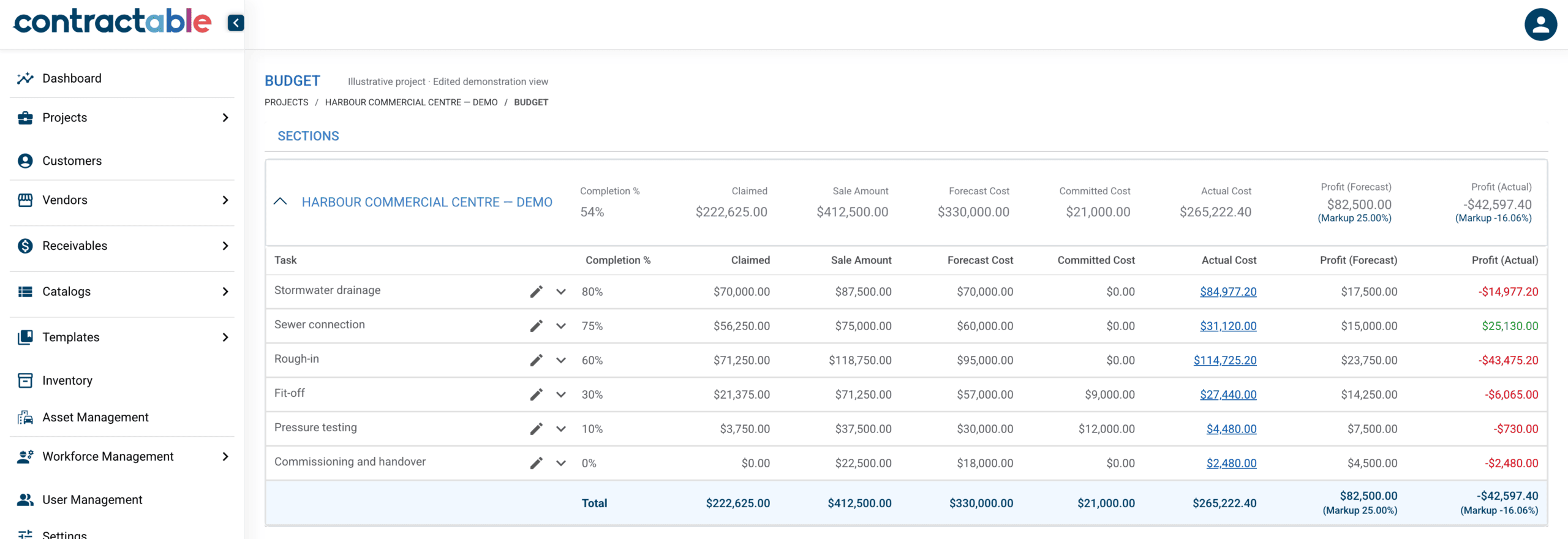
Compare the forecast cost to finish the whole job with the tendered allowance. Review actual cost, remaining commitments and the work still to complete without counting the same cost twice.
Margin visibility
Review the project’s forecast cost against its sale value. Keep the forecast for the whole job separate from the position recorded to date.
Committed cost
A priced purchase order records its known value as a commitment against the job before the supplier invoice arrives. Review the remaining unbilled commitment alongside actual cost.
Variance at task level
A job that’s three per cent over tells you almost nothing. One task line twenty-six per cent over tells you exactly where to look.
The claim record
Review the project’s claim record alongside its cost position. A claim submitted to the client is a different record from the cost of delivering the work.
The record underneath
Use the recorded hours, orders, invoices and dockets to investigate a movement in cost.
The hours matter. So does the cost of each one.
Olympia’s approved timesheets total 4,636 hours. The tendered labour rate is $146.43 an hour. The effective rate at the demonstration checkpoint is $154.10 an hour, calculated from $714,408.60 of labour cost.
Review the hours and the cost rate separately. An hours total can be right while the rate behind the estimate needs another look.
Illustrative project. Demonstration data. Rates shown rounded to two decimal places; calculations use the underlying values. Data checkpoint: 10 September 2026.
What owners say first
“We already do this in a spreadsheet.”
A spreadsheet can hold the budget. Contractable connects it with recorded orders, approved labour and claims, so the review starts with the records of the work.
“Our jobs are too different from each other.”
Map cost tracking to your job: use task detail where you need to investigate productivity, or a section-level cost bucket where that is enough. Keep the work breakdown separate from the payment breakdown.
“Who will help us get it working?”
We help map your workflow, configure the job structure and bring your rates and data into the platform. Your team keeps control of approvals and the judgement behind the forecast.
See how your jobs would run in Contractable.
Book a tailored demo with our team. Tell us the kind of work you deliver and the cost-control problem you want to solve.
- Follow a priced quote into the working budget.
- See purchasing commitments and approved labour against the job.
- Explore the cost detail behind a change in forecast.
- Discuss setup around your workflow and accounting system.
You do not need to prepare or upload project documents to enquire. We will contact you to arrange a suitable time.
Book a tailored demo
Start with your name, company and work email. The remaining details are optional.
Prefer email? hello@contractable.co. Privacy policy.