
LIVE PROJECT MARGIN CONTROL

You've been handed a profit margin to chase. Can you track it?

On most jobs, no. The number came off a spreadsheet on somebody else's laptop, three weeks ago — untraceable. Contractable carries the money on the programme itself, every task, variation, purchase order and hour, and shows the working behind every figure. Right down to the invoice.

Bring one live project. We’ll show you what it’s really making.
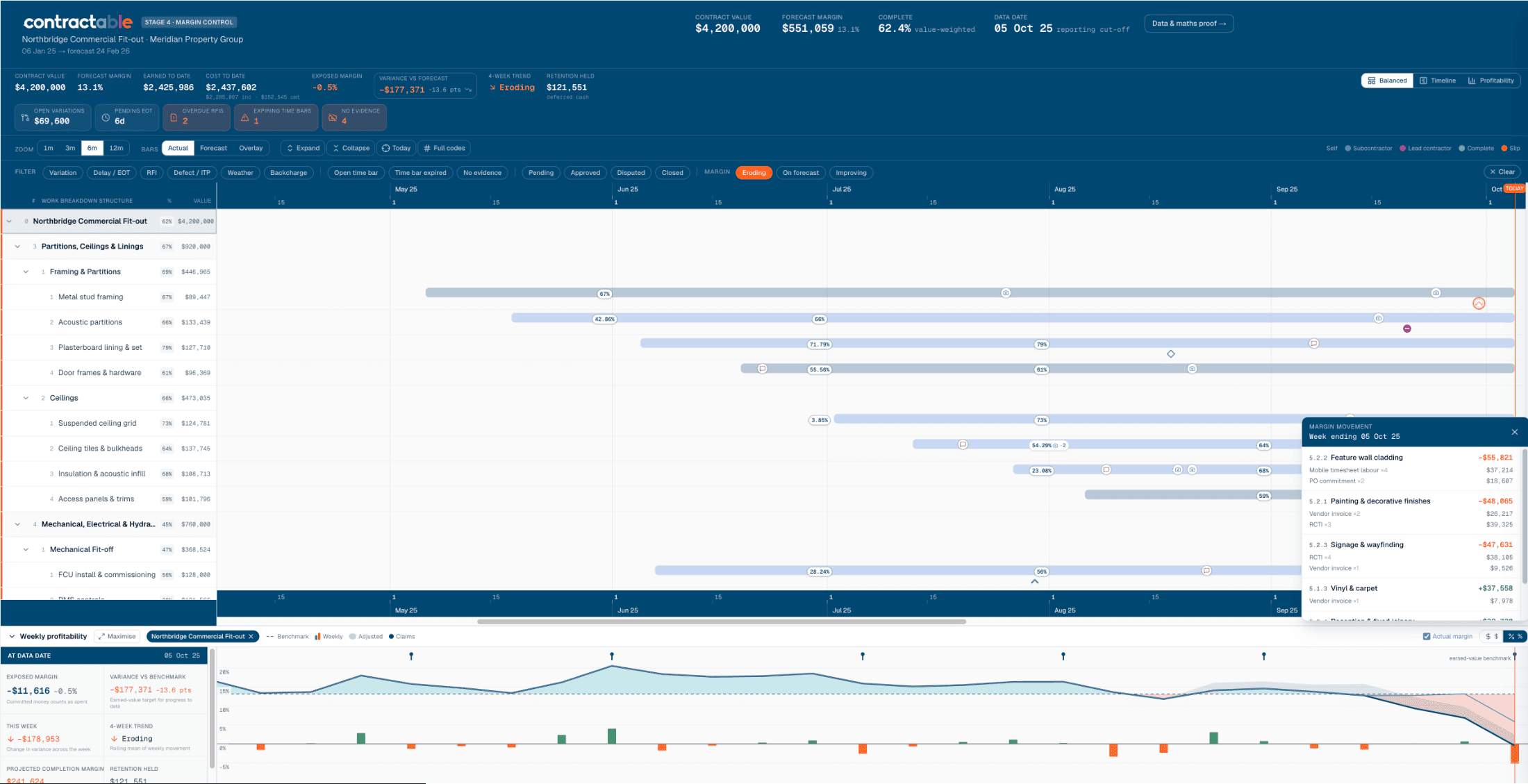
Contractable Balanced view: the header KPI strip, margin-alert chips, the work-breakdown Gantt and the weekly profitability line for one project on a single screen.
The whole job on one screen — KPI strip, alert chips, the work breakdown and the margin line together. Illustrative project. Demonstration data.
EXPOSED MARGIN

The PO's raised. The money's gone. Your P&L won't know for a month.

On this job the books show $140,929 earned in margin.

Count the purchase orders that are raised but not yet invoiced — $152,545 of them — and the job has actually made minus $11,616. Committed money counts as spent here, because on site it already is.

That's the gap that quietly eats commercial contractors, and it's the gap an invoice-driven system structurally cannot show you.

FORECAST, WHOLE CONTRACT
13.1%
EXPOSED, WORK TO DATE
−0.5%
BOOKS SHOW
$140,929
EARNED MARGIN
− COMMITTED
$152,545
ACTUALLY MADE
−$11,616
▼ ERODING
Header KPI strip showing exposed margin at minus 0.5 per cent, cost to date of 2.44 million made of 2.29 million invoiced plus 152,545 committed, and variance versus forecast of minus 177,371.
−$11,616 exposed · committed counts as spent
Forecast margin is whole-contract; exposed margin is work-to-date — different bases. Illustrative project. Demonstration data.
HOW THE NUMBER STAYS TRUE

Set it up once. After that, the job keeps it honest.

Nobody maintains the number. It falls out of the paperwork your team already pushes through every day — no double entry, no month-end reconstruction.

STEP 0 · AT PROJECT START Set it up once. Your quoting system imports as the work breakdown — money already sitting on every task. Any spreadsheet, any kit: one estimator brought 1,345 formula templates, rebuilt and quoting inside 24 hours.
THEN, EVERY DAY — FOUR THINGS YOUR TEAM ALREADY DOES KEEP IT LIVE
PO · WO · INVOICEPurchasing & invoicesCommitted cost hits the task the minute the PO is raised. The invoice and RCTI reconcile against it.
TIMESHEETTimesheet hoursApproved hours become actual cost — rate plus overheads — on that part of the job.
MOBILE EVENTEvent capture on siteVariations, delays, RFIs and ITP holds snapped on the phone, GPS-stamped, evidence attached before the notice clock runs down.
RETENTION · VARIATIONRetention & variationsRetention computes per contract; variations track raised → submitted → approved. The contract admin keeps itself.
LIQUIDATED DAMAGES

The date you can't hit costs $8,500 a day. Notice is the only thing that stops the clock.

Practical completion is one date in the contract. Miss it and liquidated damages run — every single day, straight off your retention first, then your margin. On a job running twelve months or more, that's your whole result, gone to a deadline the programme was never going to make.

Contractable carries the daily rate on the badge from day one and counts down your float. It turns red the moment your forecast finish passes the contract date — while there's still time to lodge the extension-of-time claim, delay record already attached, that moves the date and cancels the damages.

A delay you gave notice for is an extension of time. A delay you didn't is a deduction. That's the difference between finishing with your margin and watching a 12-month-plus job go up in smoke.
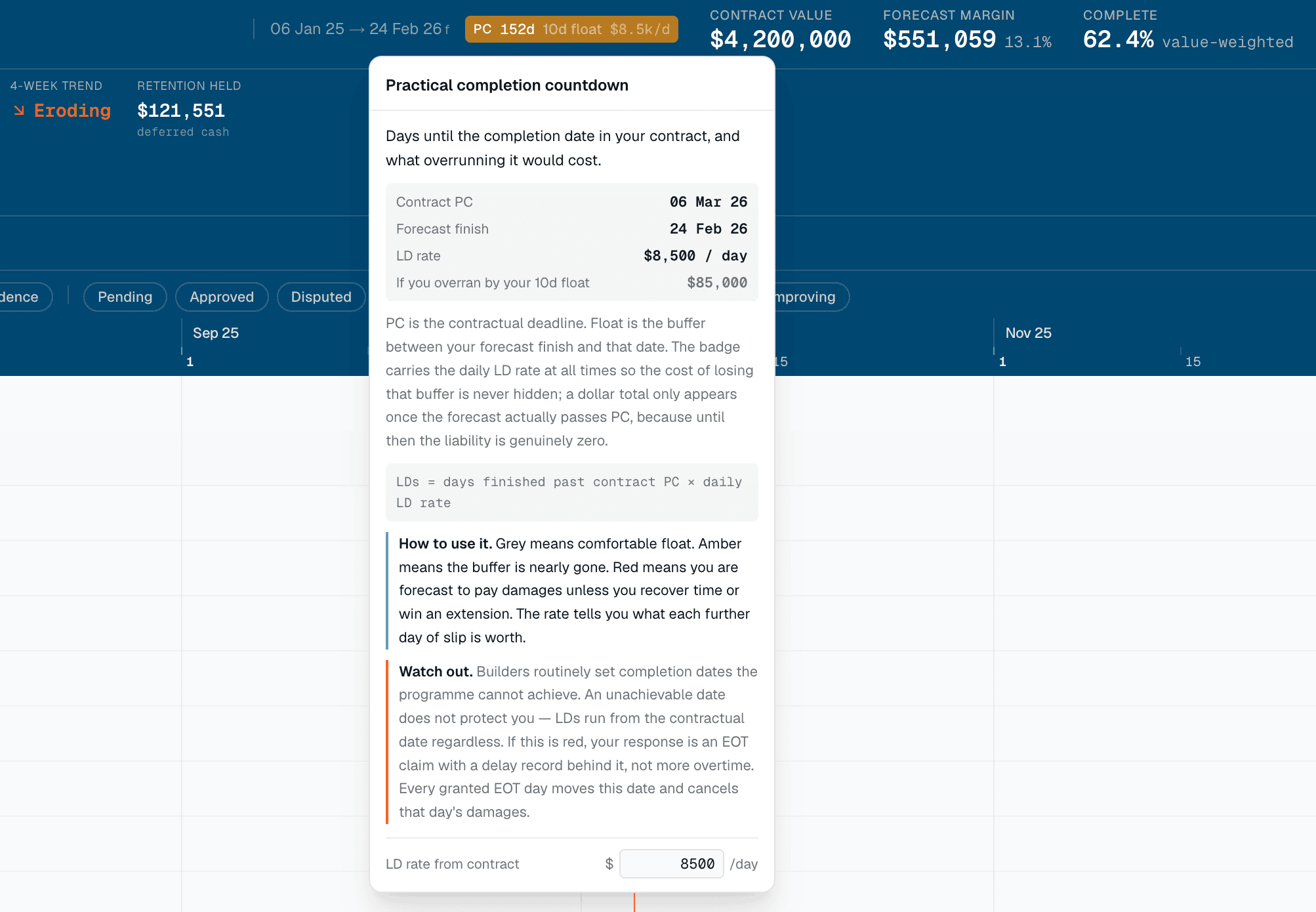
A practical completion countdown panel: contract PC date, forecast finish, an LD rate of 8,500 dollars a day, and 85,000 dollars if the ten-day float is overrun, with guidance that a granted extension-of-time day moves the date and cancels that day's damages.
LD rate, always on
$85,000 if the float's gone
Practical completion countdown. Illustrative project. Demonstration data.

FREE PROJECT REVIEW

See what one live project is really making.

Bring us one active project. We’ll review the margin, committed costs, labour, variations and programme risk to show you what your current reports may be missing.